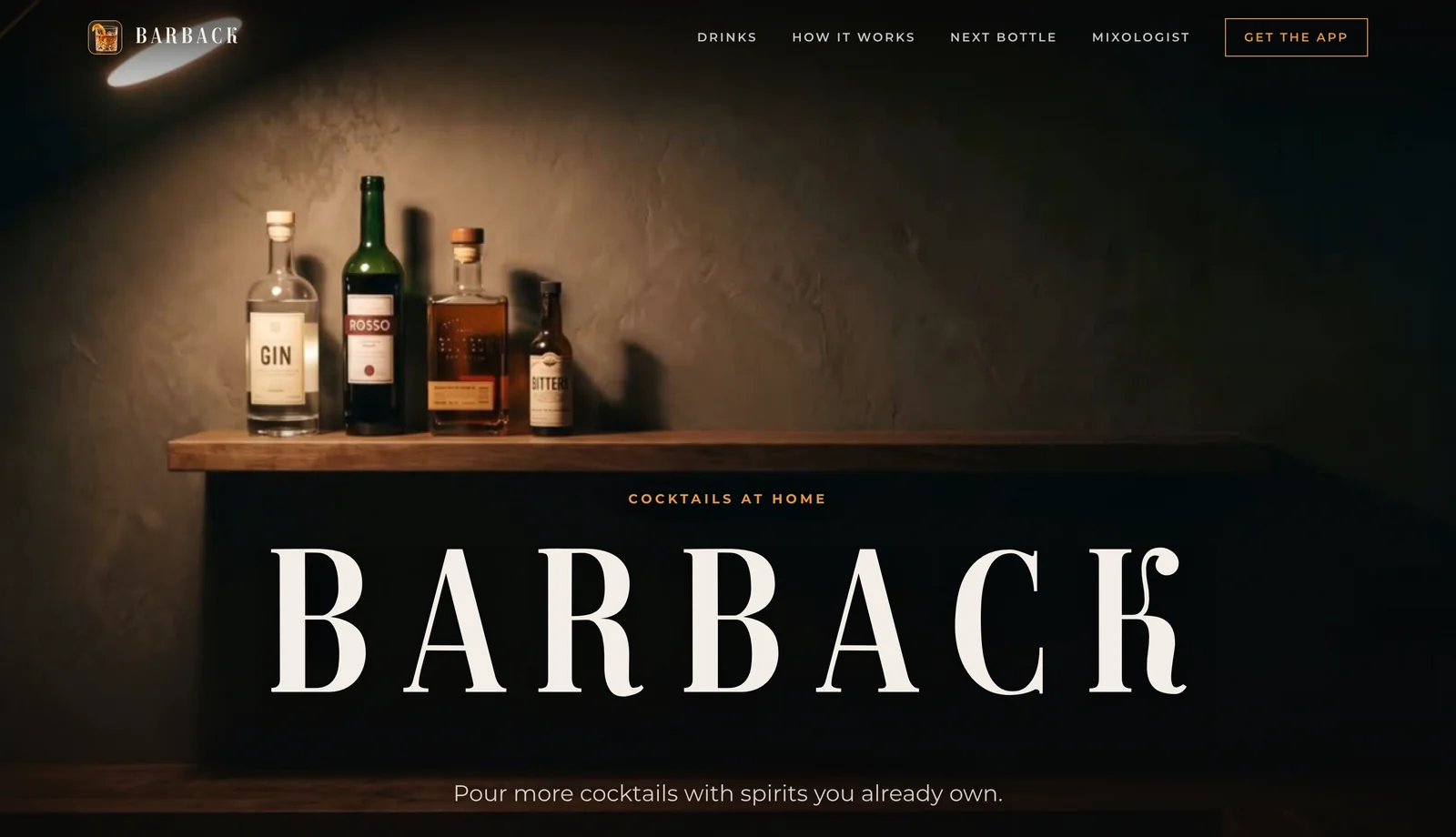
Cocktails you can pour, instantly
A cocktail app for the half-stocked home bar
- Role
- Product designerSolo, research to build
- Program
- Modules 01–06Element Education
- Year
- 2026Sept–Oct
- Shipped
- BothLanding page & prototype
Work / Barback
Drinks you can actually make tonight
Six modules of product work on one question: what can the bottles you already own actually make? Research through to a tested prototype and a live landing page.
A cocktail app for the half-stocked home bar
What I believed, against what people said
The module asks for five recorded conversations. This ran as eight written survey responses: above the floor on count, short of it on depth. Nobody could be asked a follow-up — which is why age is inferred rather than known, and why hosting, raised twice unprompted, was never chased down.
Response 08. Bought it for a block party.
The module 01 hypothesis was that being shown each step is what fixes it. If the blocker is stock rather than skill, step-by-step technique coaching is the wrong product — so it was cut, not parked.
Buys the bottle on a whim, then finds out what it needs
When I want a cocktail from the bottles I already own, I want a drink those bottles can actually make, so I can pour something good tonight without buying another bottle.
Carlisle buys a bottle because of one drink: something had at a bar, on holiday, or seen on Pinterest. The bottle comes home and the drink does not. Working out what else it needs happens later, usually too late. They are not chasing difficulty — four of eight said the thing that worked was making it simpler.
Part-stocked, bought drink by drink.
One or two new cocktails a year. 6 of 8.
Most turn out fine. 5 of 8.
Often no jigger — so ounces are useless.
Coverage, by the job rather than the feature list
Rivals get compared on a real task, not on a feature grid. Row 02 is the one Carlisle actually arrives with, and four of five rivals do not answer it at all. The fifth asks what you own, then caps you at five bottles from a closed list.
does it well half does it does not do it The highlighted rows are the opening.
Five minutes to a recipe worth believing, thirty-four to a glass. Four sources opened, two disagreeing on the liquor. Then the shelf came up short — and not one source offered a substitute, so blackberries, vodka and syrup went in on a guess. Stocking the rest hit a signup wall partway through.
It wins on the night every time: no stock, no measuring, no risk. It is also where the want is created, and where people retreat when the home attempt fails. You go home with the name of the drink and nothing else.
Both axes are rows of the coverage matrix, not a handsome guess
Thirty-three words, cut down from forty-five. Category, persona, the empty row, the named alternative and its gap: five phrases, five rows on the landscape.
One tool has started walking into it. Homebarmenu asks what is on your shelf, then caps you at five bottles, offers no substitutes, and only names a missing ingredient once you are already on the recipe. Four of five real bottles were not in its list.
Each one traced to a cluster or to the empty row
Everything that served the roadmap instead of the evidence is cut. Technique coaching and sharing went because they served the killed claim. Video is parked, not cut: the format was never tested.
Enter every bottle on the shelf — all of them, including the ones no catalogue lists — and see only the drinks actually within reach.
For drinks just out of reach, name the single ingredient that unlocks them, so a bottle never sits unopened in a basement again.
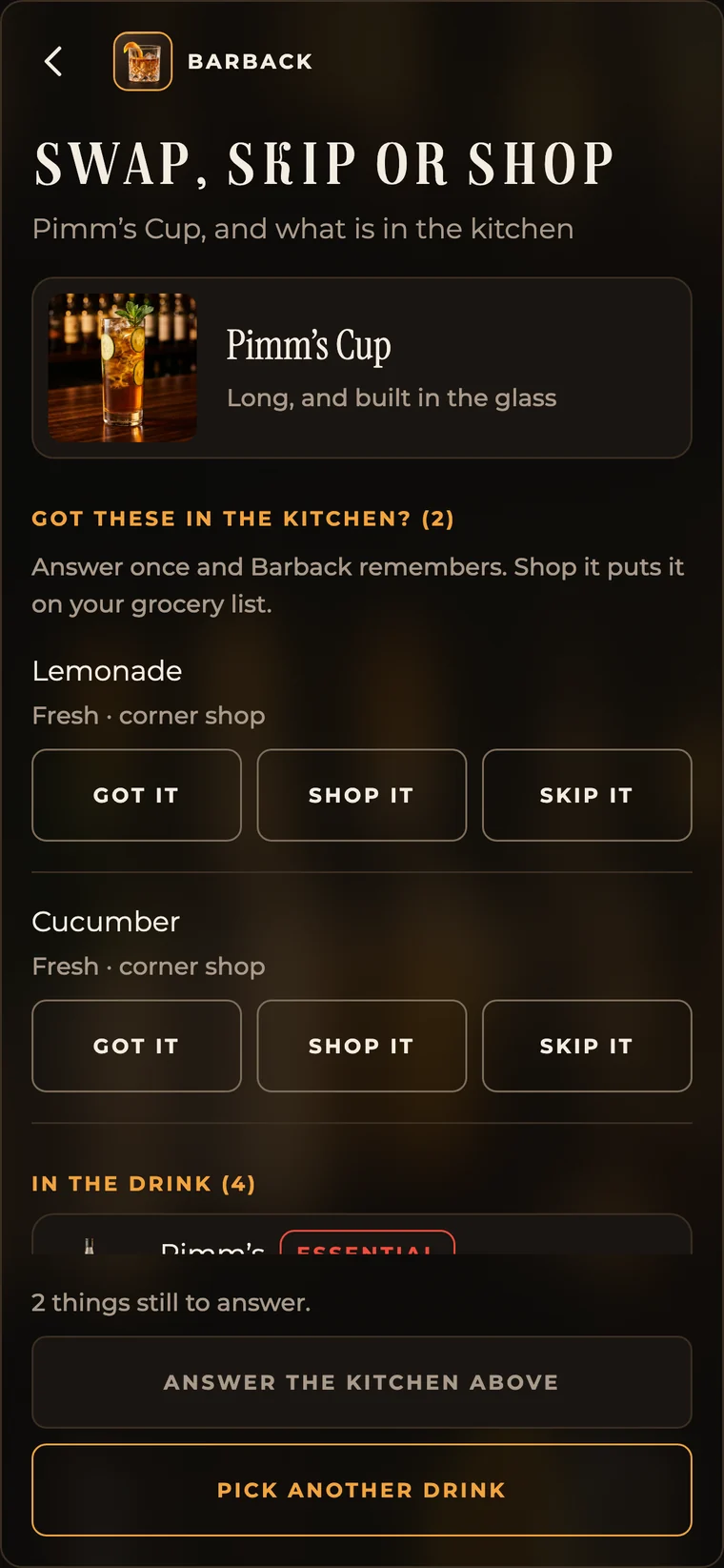
Every ingredient marked essential, swappable or skippable, with what to use instead. No rival does this: row 03 is empty across the matrix.
Ratios in parts, scaled to whatever vessel they own. Four of eight eyeball it and it comes out too strong.
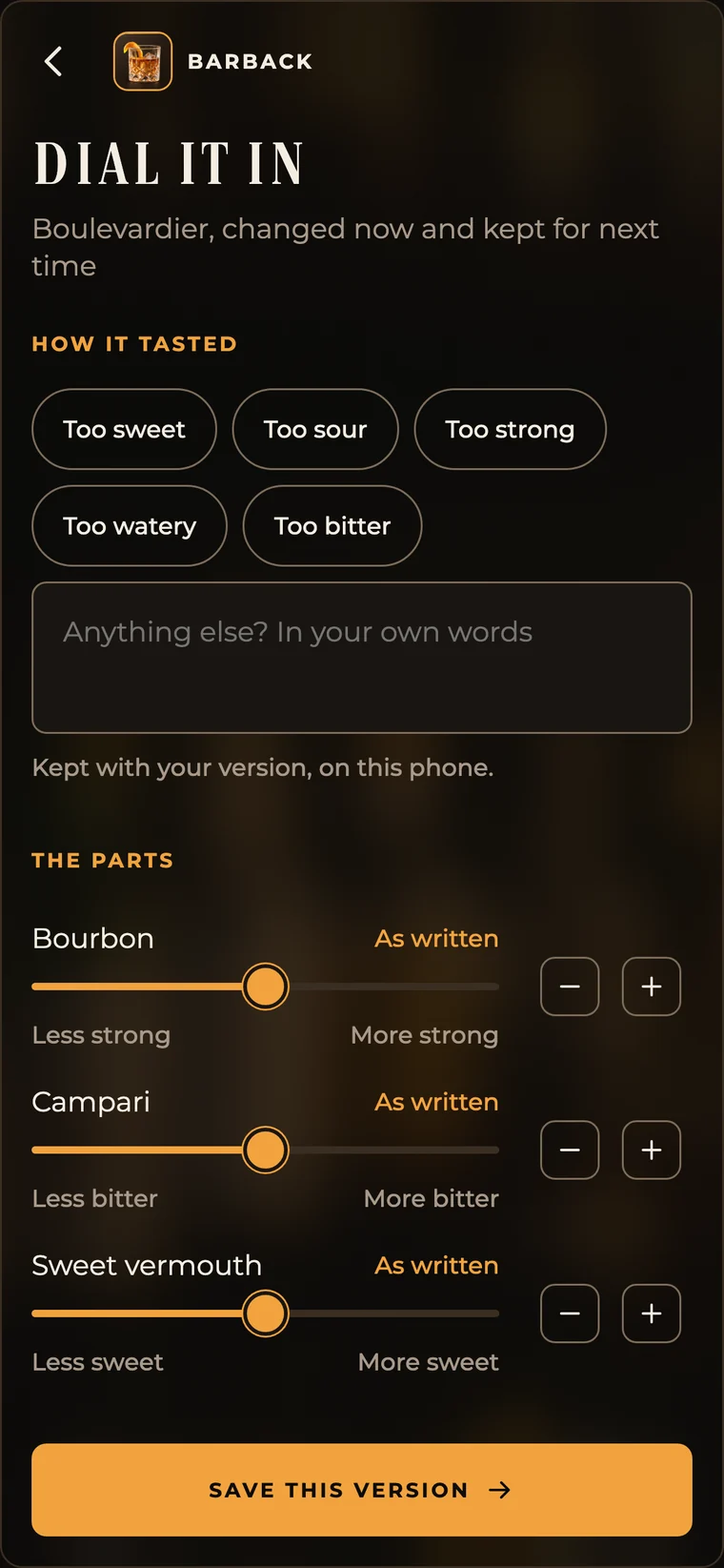
Adjust the drink to taste and keep the version, so the second pour starts where the first one ended.
An ounces-to-tablespoons converter and glassware guidance. Feature 04 never uses ounces and already scales to the vessel they own.
Untested, not disproved. Batch for guests — raised twice, never asked about. Import from a link. Swap confidence, once swaps have been rated.
Step-by-step technique coaching, social and sharing. They served the claim the interviews killed. “What one bottle unlocks the most” went too: the position is built on not shopping.
Three steps is the ceiling — any longer and Google wins
Google is free and already open. A longer path does not lose to a better app, it loses to the one the user already has. So the home screen is the answer, not a search box.
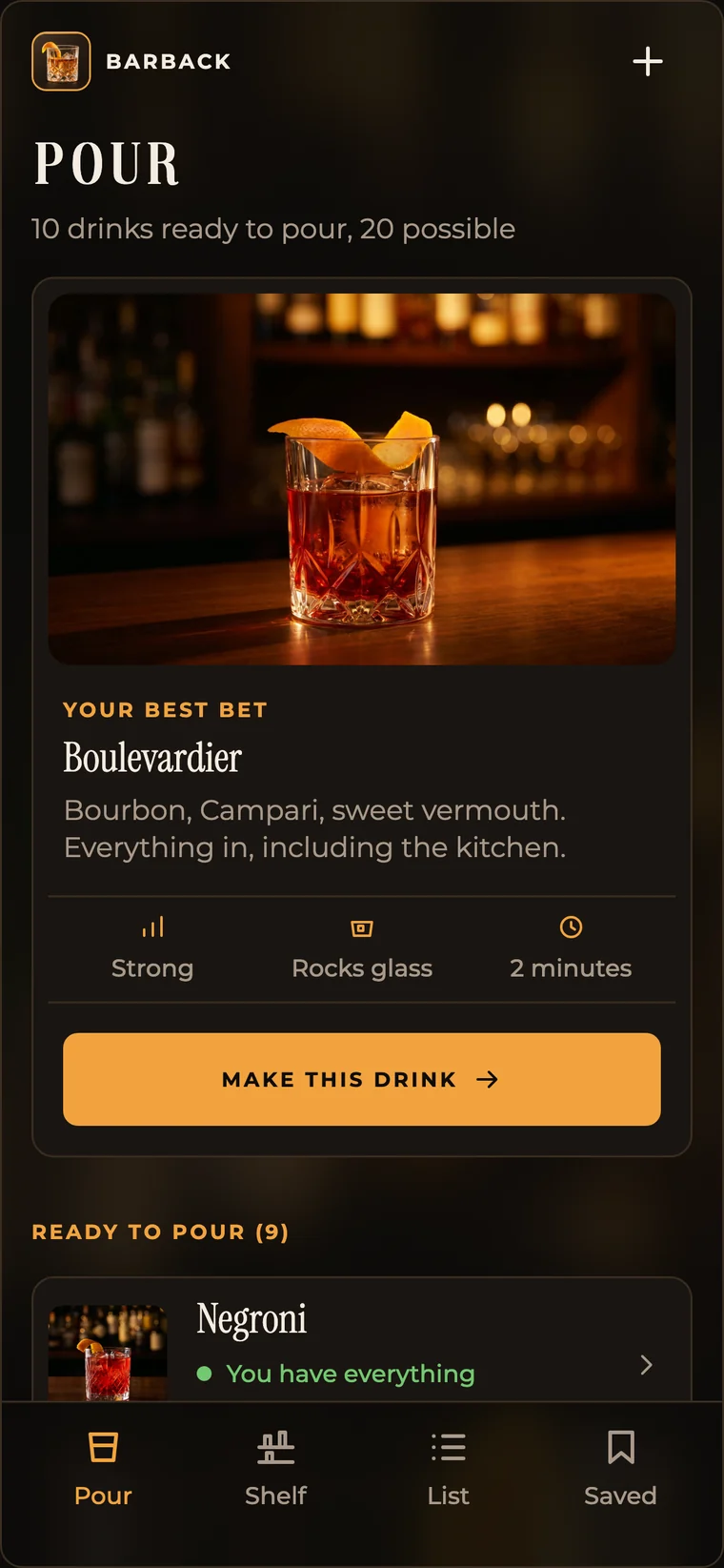
Tonight is the whole home screen: the drinks your bottles can actually make, right now.
The pour, in parts, scaled to whatever vessel is to hand. No ounces, no jigger.
Three taps, no shopping trip, no bottle bought for one recipe.
First run: add your bottles in free text — any bottle, no account. The rival caps the shelf at five from a closed list.
One bottle short, or on a first run: the two lists that unlock the most drinks.
Swap, skip or shop, decided on the missing thing’s own row.
Dial it in, and the next pour starts from the version that worked.
Built before the pixels, so the hi-fi week invented nothing
Thirteen color tokens in dark and light: one gold with two jobs, a warm hairline round cards and a stronger edge for controls. Green means you have everything; it is never decoration.
16 inside cards, 8 between them, 24 between sections, 32 above an empty state. Buttons 48 tall. Set once as variables, reused on every screen. Nothing eyeballed.
Inputs, buttons, cards, rows, chips and dialogs — each built from tokens, each with its hover, error and empty states, and each naming the screens that use it.
Every value from the system, every word from the flow
Three times a screen needed something the system did not have. Each time the change went into the system, was rebuilt and checked, and only then appeared on a screen — a confirm row that answers three ways, a shelf row ending in × rather than a menu that was not there, and a suggesting field.
Click any screen to see it full size.
One job each — shown on the build running today, with the test’s fixes in it
Every serious bug in the build week had the same shape: the screen claiming something it could not back up. A best bet promising a Boulevardier on a shelf that could not make it. “Saved for next time” on a drink nobody saved. The fix was always the same — compute it from the shelf and the recipes, never type it in.
Every screen was asked out loud what it does when it is empty, when it breaks, and when it is waiting. Empty: one line and one action. Error: what broke, in plain words, with the user’s input kept. Loading: none designed, because nothing waits — everything is on the phone.
Five participants, five tasks, on the live prototype
Five sessions is a small sample, and one of the five was an AI agent run alongside the four people — so the four-person figures sit beside the totals throughout. This is a strong early signal, not proof.
Ease ran 1 to 5. Twenty-three of twenty-five attempts scored a 5 — every exception was task 5.
Every insight ends in a design change, or it isn’t an insight
The swap works once people reach it — four of five finished it unaided. Reaching it was the problem: the slowest task in the session, and the only one that needed help. So the fixes move it forward rather than explain it better.
The most direct request in the test: people expected to type a drink’s name. It was built — and removed. Searching every drink brings back the competitors’ pain point, recipes for bottles you don’t own. The need behind it is answered on Pour instead, where One Trip Away now lists the nearest drinks a bottle short, swappable ones first.
The scroll film, running here — no need to leave the page
Scroll inside the frame to play the film: the camera follows the liquid down from the shelf, through the pour, into the glass. Built in GSAP and Lenis, with the world drawn in SVG rather than filmed.
The tested build — the same one the five sessions ran on
Add a few bottles and it will show you what they can actually make. Everything is on the phone, so nothing waits and nothing is sent anywhere.